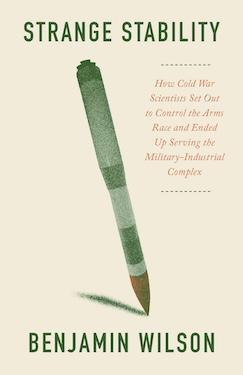
Strange Stability

ISBN

Publisher

Imprint

Year Published

Print Length

Format

SKU

25580

Original price was: ₨14,669.00.Current price is: ₨2,070.00.

An eye-opening reconsideration of the Cold War arms control movement, showing how scientists who presented themselves as independent-minded opponents of the arms race in fact functioned as agents of the military-industrial complex that profited from it.

Description

Do scientists speak truth to power? During the Cold War, a group of elite American strategists and science advisors claimed to do precisely that. Styling themselves as figures of rationality and restraint, they insisted that mutual assured destruction was the natural logic of the atomic age: as long as nuclear deterrence was credible, no one would ever shoot first. This doctrine, known as “strategic stability,” became the foundation of the arms control movement, earning its promoters widespread admiration as independent thinkers and steadfast peacemakers. But in this crucial counterhistory, Benjamin Wilson shows that we have misunderstood them and their efforts. Arms controllers, he reveals, worked not to restrain the nuclear arms race but to marginalize more radical approaches to disarmament.

As Wilson makes clear, strategic stability was never the objective condition the analysts presented it as. It was a flexible, contested metaphor based on ideas from physics, economics, and cybernetics, capable of justifying a wide range of policies. Yet the advisors insisted on one upshot above all: constant military research and development and the continuous upgrading of America’s strategic arsenal. That these policies benefited the military-industrial complex is no surprise, since many arms control thinkers were creatures of the Pentagon and corporate defense contractors. Some even spoke out against missile development in public while backing lavish funding behind closed doors.

Strange Stability powerfully corrects decades of mythmaking surrounding arms control. At the same time, Wilson offers a sobering reflection on the dream of technocratic restraint. The well-placed insider who resists powerful institutions is an enticing character, but more fictional than real.

Praise and Reviews

Not available

About the Author

Strange Stability

An eye-opening reconsideration of the Cold War arms control movement, showing how scientists who presented themselves as independent-minded opponents of the arms race in fact functioned as agents of the military-industrial complex that profited from it.

Description

Do scientists speak truth to power? During the Cold War, a group of elite American strategists and science advisors claimed to do precisely that. Styling themselves as figures of rationality and restraint, they insisted that mutual assured destruction was the natural logic of the atomic age: as long as nuclear deterrence was credible, no one would ever shoot first. This doctrine, known as “strategic stability,” became the foundation of the arms control movement, earning its promoters widespread admiration as independent thinkers and steadfast peacemakers. But in this crucial counterhistory, Benjamin Wilson shows that we have misunderstood them and their efforts. Arms controllers, he reveals, worked not to restrain the nuclear arms race but to marginalize more radical approaches to disarmament. As Wilson makes clear, strategic stability was never the objective condition the analysts presented it as. It was a flexible, contested metaphor based on ideas from physics, economics, and cybernetics, capable of justifying a wide range of policies. Yet the advisors insisted on one upshot above all: constant military research and development and the continuous upgrading of America’s strategic arsenal. That these policies benefited the military-industrial complex is no surprise, since many arms control thinkers were creatures of the Pentagon and corporate defense contractors. Some even spoke out against missile development in public while backing lavish funding behind closed doors. Strange Stability powerfully corrects decades of mythmaking surrounding arms control. At the same time, Wilson offers a sobering reflection on the dream of technocratic restraint. The well-placed insider who resists powerful institutions is an enticing character, but more fictional than real.

Praise and Reviews

Not available

About the Author

Shopping Cart
Your cart is currently empty!.

You may check out all the available products and buy some in the shop.

Continue Shopping
Add Order Note
Estimate Shipping